Melbourne is famously good at first impressions. The coffee actually is that good. The trams actually do go everywhere. The laneways actually are lined with tiny bars. What newcomers rarely see coming is how easy it is to spend six months here without properly meeting anyone. There is so much to do on your own that going alone starts to feel like a lifestyle rather than a problem.
This is a first month plan for the social side. Which scenes live in which suburbs, what Melbourne is actually into right now, where real people meet other real people, and one specific thing you can do in your first week that makes the whole thing easier.
Written for people in their 20s and 30s who work full time and would rather not spend every weekend at a cafe by themselves.
Week 1: Learn how the city sorts itself socially
Melbourne's neighbourhoods have real personalities and they don't blur into each other the way Sydney's do. Northside and southside is a real thing. Which side of the city you land on will quietly shape who you meet for years. Walk through a few before you sign a longer lease.
Here is the honest version of what each area is actually like on a weekend:
By the end of week one you should have spent time on both sides of the Yarra. The northside and southside divide is real, and it shapes who you meet more than any other single decision in your first year.
Week 1 close-out: Introduce yourself to your suburb
Most newcomer guides skip straight to "join a run club." The problem is that the run club is on Saturday and you moved on a Tuesday, and by Friday you haven't spoken to anyone in Melbourne except a real estate agent and a barista.
HillSnaps in the Hilltops app is built for exactly that gap. It's a nearby people surface. You post a short intro and it shows up to people within about two kilometres of you. Everything expires after seven days, so nothing lingers.
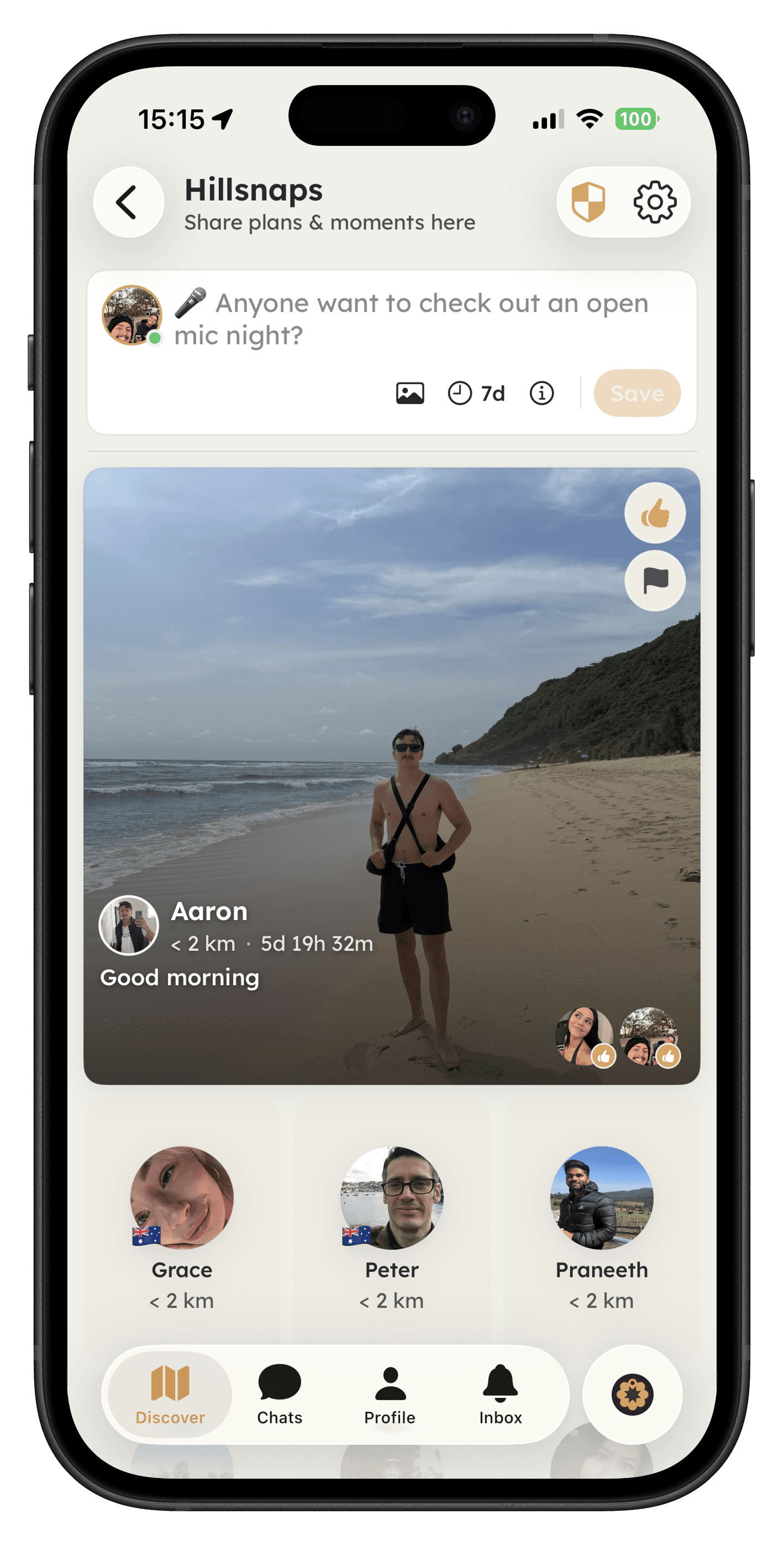
HillSnaps: nearby plans, moments, and people, all in one place.
A HillSnap intro is just a warm hello with a small ask. Your name, photo, and suburb come from your profile, so all you need to write is what you're into and one small thing you'd be keen to do.
Here is a real one. This is Mia, freshly arrived in Melbourne on a working holiday:
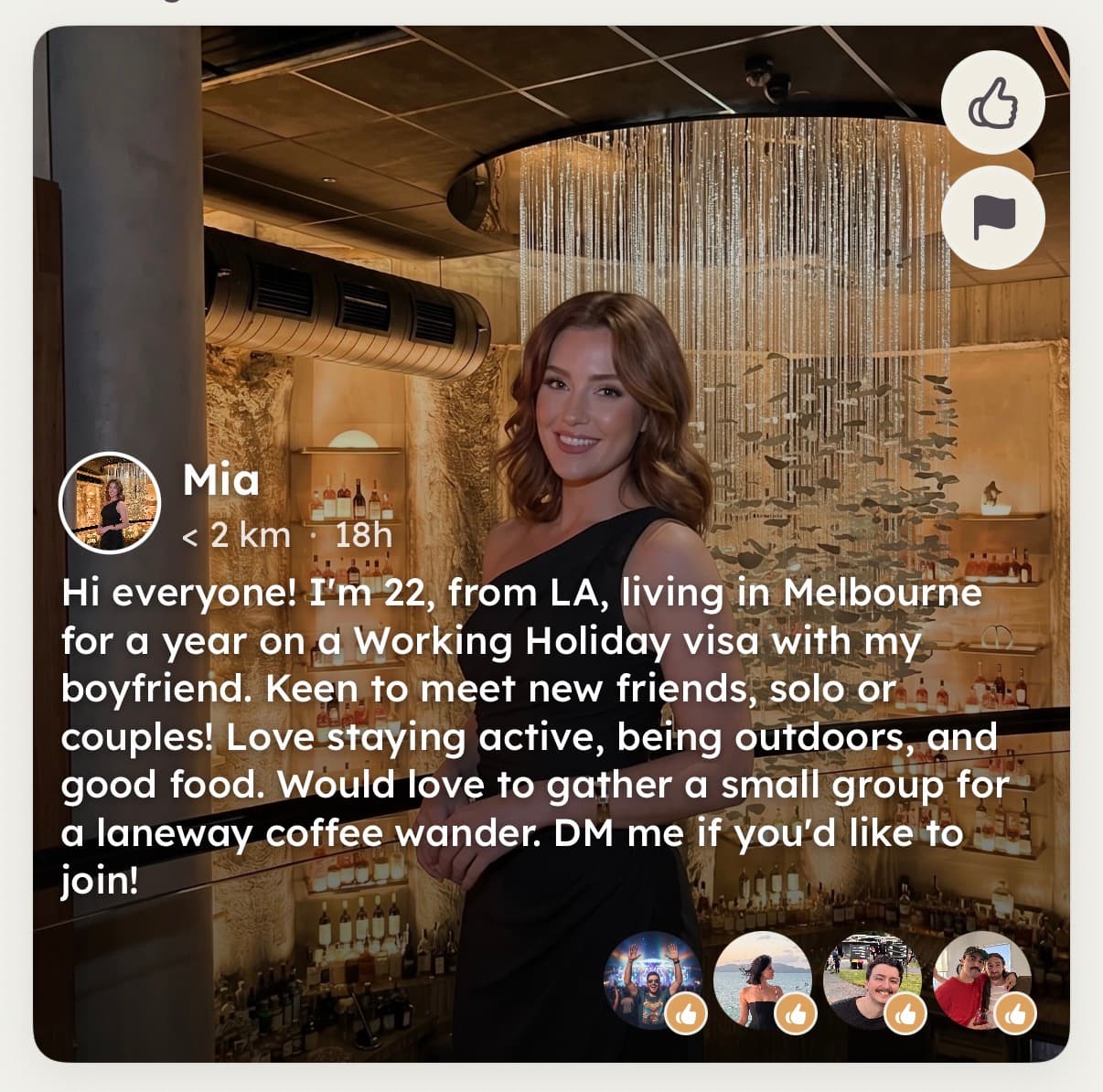
Warm, specific, easy to reply to.
For a Fitzroy arrival in their 20s, something like this works:
"Hi Fitzroy. Just moved from Adelaide for work and living near Brunswick Street. Into coffee, live music, and finding a good bookshop. Keen for a Sunday morning walk around the Fitzroy Gardens with a coffee stop. DM me!"
Ninety seconds to write. On a normal weekend, a post like that gets reacts and replies from other new arrivals in your suburb before Sunday night. It costs nothing and it makes everything else in this guide easier.
Weeks 2 and 3: Pick one recurring social anchor
This is the most important call of the first month. Recurring activities, the same one every week, are how strangers become friends. One off events feel productive but rarely produce anyone you stay in touch with.
Melbourne has a lot of good options. Pick one and commit to it for four Saturdays straight:
- →Parkrun. Free five kilometre run every Saturday at 8am. Princes Park in Carlton, Albert Park lake, Yarra Bend, Studley Park, Ferntree Gully, Point Cook, and a dozen other courses across greater Melbourne. All paces welcome. Coffee after is the social part.
- →A run club along the Tan. The 3.8 kilometre loop around the Royal Botanic Gardens is Melbourne's unofficial running headquarters. Various run clubs meet from cafes and running stores through the week. Slower paces are welcomed. Post run coffee is the point.
- →A social sport league. Reclink Australia, Social Sports Australia, and community leagues run mixed netball, touch footy, soccer, ultimate frisbee, and dodgeball across the inner north and inner south. Designed for solo signups. You get placed on a team that needs a player.
- →A board game or hobby night. Melbourne has a dense scene of board game cafes across Fitzroy, Northcote, and the CBD, with regular open nights that welcome solo players. Low pressure and easy to go back to weekly.
- →A multi week class. Pottery in Brunswick, life drawing in Fitzroy, cooking through the Preston Market, or a language class through the Melbourne Language Institute. Anything that runs across six or eight weeks beats a one off workshop, because the value is the repeated exposure to the same people.
- →Bike Melbourne. The Capital City Trail and the Yarra path are cycling social routes as much as commutes. Community cycling groups run weekly rides that finish at a pub or cafe.
Pick one. Not three. Three becomes a chore and you'll quietly stop going to all of them. One thing, every week, until the regulars know your name. That is the foundation everything else builds on.
Week 4 onward: Melbourne's social calendar
By week four you should have a routine. The same Saturday morning thing, a coffee spot you keep going back to, a few names you know from HillSnaps replies. Now add a second commitment on a different day, tied to something you care about.
Melbourne's annual calendar is denser than any other Australian city. Even one or two of these per year changes how the city feels:
- →Australian Open (January). Two weeks of tennis at Melbourne Park. Ground pass is cheap, night sessions have their own vibe, Grand Slam Oval is a scene.
- →Midsumma Festival (January to February). Three weeks of queer arts, performance, and parties across the city.
- →Melbourne Food and Wine Festival (March). Long lunches, chef events, cellar door tours, and everything in between across Victoria.
- →Moomba Festival (March). Long weekend of free events along the Yarra. Fireworks, birdman rally, waterskiing, cardboard boat race.
- →Melbourne International Comedy Festival (March to April). One of the three biggest comedy festivals in the world. Every venue you know and a hundred you don't, running shows nightly.
- →Rising (June). Winter arts festival across the CBD, replacing White Night. Late night gallery openings, live music, and outdoor installations.
- →Melbourne International Film Festival (August). A fortnight of festival cinema across the Forum, ACMI, and the Kino.
- →AFL Grand Final Week (September). Even if you don't follow footy, the city becomes something specific in Grand Final week. Grand Final Eve is a public holiday.
- →Melbourne Fringe (September to October). A month of independent theatre, comedy, cabaret, and music across small venues.
- →Melbourne Cup Carnival (November). Four days of racing, but really a week of parties and events across the city.
A tip most people miss. Volunteering at a festival gets you inside the crew rather than the audience. It's the single fastest way to build a network in Melbourne if you don't mind the shift work.
What Melbourne is actually into right now
Every city has its dominant social currencies. Melbourne's are loud and specific. If you find your place in one or two of these, the rest of the city opens up quickly:
If you moved here in your 30s
Melbourne is arguably the easiest Australian capital to socially integrate into in your 30s. Almost everyone in Melbourne moved from somewhere else, and the culture treats that as normal rather than suspicious. There is no established local set that you need to break into. There are only overlapping scenes, all of which will welcome someone who keeps showing up.
Weight your effort toward things that attract other newcomers. Run clubs, social sport, art openings, Sunday markets, and festival volunteering all skew heavily toward people in the same boat as you.
HillSnaps helps here too. "New to Melbourne" in your intro is a small but real signal that quietly connects other people in exactly the same position.
Finding others going, before you walk in alone
The friction most newcomers quietly bail on is the first time they turn up to a thing alone. Walking in cold, knowing no one, is the point where the plan usually collapses. That is the gap Hilltops was built to close.
Two features do most of the work:
- HillSnaps. Introduce yourself to your suburb. Post plans like "keen for Princes Park parkrun tomorrow, first timer" so nearby people can decide to come along. Everything is ephemeral, so nothing lingers.
- Rooms. Group chats organised around specific events and activities in Melbourne. See who else is going before you walk in, message them, and arrive with a familiar name in the room.
For the longer game, past the first month, see our guides on how to make friends in Melbourne, moving to a new city alone, and solo events in Melbourne.
Frequently asked questions
What suburb should I live in Melbourne in my 20s or 30s?
It depends on the kind of life you want. Fitzroy, Collingwood, and Brunswick lean creative and walkable, with live music and small bars on the doorstep. Northcote and Thornbury are the same energy a tram further out. Carlton has cafes, Italian food, and a strong uni feel. Richmond gives you Corner Hotel, MCG walking distance, and quick city access. St Kilda has the beach, the Palais, and a lot of new arrivals. Windsor and Prahran skew brunch and Chapel Street. Spend a weekend in a few before signing a longer lease.
How do I make friends after moving to Melbourne?
Pick one recurring activity in your first month and commit to it for four weeks straight. Princes Park or Albert Park parkrun on Saturdays, a Tan Track run club, a social sport league, or a board game night at one of the inner north cafes. Seeing the same faces every week is how strangers turn into friends. It usually takes three to six months to feel like you have a real social circle in a new city.
How do I meet people in Melbourne if I literally know no one?
HillSnaps in the Hilltops app is designed for this. Post a short hello with one small thing you're keen to do, and it shows up to people within about two kilometres of you. Posts expire after seven days so nothing sticks around. It's the fastest way to exist to your suburb before you've been anywhere.
What is Melbourne actually into right now?
Coffee as identity, still. Live music at small venues has quietly kept going through everything. Run clubs meet nightly across the inner north and along the Tan. Comedy is enormous, thanks to the Melbourne International Comedy Festival in March and April. Footy tribalism runs the winter. Natural wine, board game cafes, laneway bars, sport at the MCG, and NGV blockbusters do most of the everyday social work.
Can I make new friends in Melbourne in my 30s?
Yes, and Melbourne is arguably the easiest Australian capital for it. Almost everyone in Melbourne moved from somewhere else, so the social need is widely shared and no one thinks it's weird that you're starting over. Adult friendships take longer to form than they did at university, but the ingredients are the same. Recurring shared activity, repeated contact, and being the one who suggests the second hang.